
 Contact
For many visitors, Balat begins with a photograph.
Rows of colorful houses climb the hills above the Golden Horn. Laundry hangs between buildings, cats sleep on doorsteps, and small cafés occupy corners that seem made for Instagram. Over the past decade, these images have turned Balat into one of Istanbul’s most recognizable neighborhoods.
But the colorful houses are only the surface.
Walk deeper into Fener and Balat and another Istanbul begins to appear: Greek Orthodox churches, synagogues, mosques, old workshops, market streets and houses shaped by communities that lived around the Golden Horn for centuries.
These neighborhoods tell a story not simply about monuments, but about migration, religion, trade and everyday urban life.
Greeks, Jews, Armenians, Muslims, Bulgarians and others lived, traded and worshipped around these streets through periods of coexistence as well as profound political and social change. Their traces make Fener and Balat one of the most revealing places to explore Istanbul beyond its monumental center.
Fener and Balat: Two Neighborhoods, Not One
Today, Fener and Balat are so often mentioned together that visitors can easily assume they are simply two names for the same place.
Historically, however, they developed distinct identities.
Fener became particularly associated with Istanbul’s Greek Orthodox community. After the Ottoman conquest of Constantinople in 1453, the Ecumenical Patriarchate eventually established itself here, making the neighborhood one of the most important centers of Orthodox Christianity.
Balat, immediately beside it, developed a particularly strong association with Istanbul’s Jewish population. Jewish communities had existed in Constantinople long before the Ottoman period, while later migrations—including Sephardic Jews arriving in Ottoman lands following expulsions from the Iberian Peninsula at the end of the 15th century—added to the city’s already diverse Jewish population.
Yet it would be misleading to imagine an invisible wall separating a “Greek Fener” from a “Jewish Balat.”
These were dense Ottoman neighborhoods. People encountered one another in markets, workshops and commercial streets. Armenians and Muslims also lived in the wider area, while the Golden Horn connected the neighborhoods to a much larger network of merchants, sailors, artisans and migrants.
That complexity is precisely what makes Fener and Balat so interesting.
Why Fener and Balat Matter to Istanbul’s History
To understand these neighborhoods, it helps to look first at the Golden Horn.
For centuries, this natural harbor was one of Istanbul’s great commercial arteries. Goods and people moved along its shores, workshops operated nearby, and neighborhoods developed around trade, religion and community networks.
Fener and Balat were therefore not peripheral picturesque quarters. They belonged to the working and commercial geography of an imperial capital.
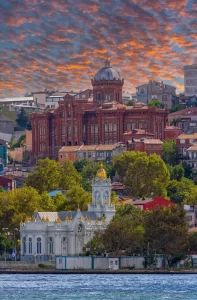
After the Ottoman conquest, Istanbul underwent major demographic change. Mehmed II sought to repopulate and revive a city whose population had declined considerably during the final centuries of the Byzantine Empire. Muslims, Christians and Jews from different parts of the expanding Ottoman territories came to the capital through both voluntary migration and state-directed resettlement.
The Istanbul that emerged was not culturally uniform.
Its neighborhoods often developed around religious institutions, occupations and networks of family and origin. Churches, synagogues, mosques, markets, workshops and houses formed an urban fabric in which community identity and everyday commerce existed very close to one another.
Fener and Balat still preserve traces of that world—not because they have remained unchanged, but because successive communities left marks that can still be read in their streets.
Fener: The Greek Orthodox and Phanariot World
The name Fener is generally associated with the Greek fanari, meaning a lantern or lighthouse, probably reflecting the area’s historic relationship with the Golden Horn waterfront.
The neighborhood became especially important to the Greek Orthodox population during the Ottoman centuries.
At its heart stands the Ecumenical Patriarchate of Constantinople, one of the most important institutions in Orthodox Christianity.
The Patriarchate’s presence helped make Fener far more than a residential quarter. It became an important religious and intellectual center, and wealthy, educated Greek Orthodox families became increasingly prominent in the district.
From this environment emerged the families commonly known as the Phanariots, named after Fener.
Some accumulated considerable wealth, education and political influence. Their knowledge of European languages and diplomatic networks made members of these families particularly valuable as interpreters and diplomats within the Ottoman administrative system. Some later held important positions in the Danubian principalities of Moldavia and Wallachia.
Their story complicates any simple picture of Ottoman Istanbul as a city divided neatly between rulers and minorities. Religion, wealth, education and political influence could intersect in much more complicated ways.
One of Fener’s most striking landmarks reflects this legacy.
High above the neighborhood stands the imposing red-brick Fener Greek High School. Its scale surprises many first-time visitors, particularly when seen rising above the narrow streets below.
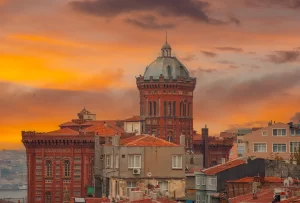
Nearby, the Patriarchal Church of St George presents almost the opposite impression. Compared with the monumental churches visitors may associate with Christianity elsewhere, its exterior is relatively restrained.
The contrast itself offers a glimpse into the different historical circumstances in which Istanbul’s Christian institutions developed after the Ottoman conquest.
Balat and Istanbul’s Jewish Heritage
A few streets away, another historical layer becomes visible.
Balat has long been associated with Istanbul’s Jewish history, although that story is more complicated than the familiar idea that Sephardic Jews arrived from Spain and simply created a new community here.
Jews had lived in Constantinople before the Ottoman conquest. Romaniote Jewish communities had roots in the Byzantine world, and the Ottoman capital later received Jewish populations from different regions.
The expulsions from Spain in 1492 and Portugal shortly afterwards brought an important new Sephardic migration into Ottoman lands. Over time, Sephardic culture—particularly the Ladino language—became a major element of Jewish life in Istanbul and other Ottoman cities.
Balat developed into one of the city’s important Jewish quarters.
Among its most significant surviving institutions is the Ahrida Synagogue, whose origins are traditionally associated with Jews from Ohrid in the Balkans.
That detail matters because it reminds us that Ottoman Istanbul’s Jewish world was not created by a single migration. People arrived from the Balkans, Iberia and elsewhere, bringing traditions that interacted and evolved within the city.
Jewish Life in Balat Beyond the Synagogues
Jewish life in Balat was also not confined to religion.
People worked as merchants and artisans, operated shops and participated in the commercial life of the Golden Horn. The neighborhood was a place of families, schools, food, work and ordinary routines—not simply a collection of religious monuments.
During the 19th and especially the 20th century, that demographic landscape changed considerably. Economic mobility encouraged some families to move to other districts, while nationalism, discriminatory policies, political upheavals and emigration transformed Istanbul’s non-Muslim communities more broadly.
The Balat we walk through today is therefore not a frozen remnant of an Ottoman Jewish quarter.
It is a neighborhood shaped by both presence and absence.
Sometimes the absences tell as much history as the buildings that remain.
More Than Greek and Jewish
Reducing the area to “Greek Fener and Jewish Balat” leaves out another important part of the story.
The wider Golden Horn was home to Armenians, Bulgarians, Muslims and other communities, and their institutions remain part of the landscape.
One of the most extraordinary examples is the Bulgarian St Stephen Church, standing close to the shore.
Often called the Bulgarian Iron Church, it is famous for its prefabricated iron structure. But its significance goes beyond unusual architecture. The church also belongs to the history of the Bulgarian community in Ottoman Istanbul and the 19th-century movement for an independent Bulgarian ecclesiastical identity.
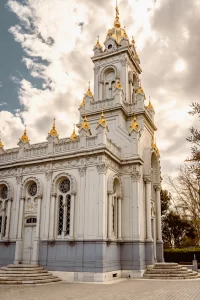
Even communities that shared the Orthodox Christian faith did not necessarily share the same political or cultural ambitions.
Nearby mosques, Muslim residences and later waves of migration add further layers.
As Istanbul changed during the 20th century, families arriving from different parts of Türkiye settled in districts once heavily populated by non-Muslim communities. Houses changed occupants. Buildings acquired new uses. Workshops opened and closed. Each generation interpreted the neighborhood differently.
This is why walking through Fener and Balat should not become a search for one “authentic” historical period.
There are many.
The Colorful Houses of Balat
And then, of course, there are the houses.
They deserve attention—but perhaps for different reasons than their popularity on social media suggests.
The narrow façades, bay windows, steep streets and closely packed buildings tell us about urban life in a dense historic neighborhood. Some houses have been dramatically restored; others still show the effects of age, repeated alteration and changing economic circumstances.
The colors visitors photograph today should not automatically be treated as a perfectly preserved Ottoman color palette.
Neighborhoods evolve. Buildings are repainted, restored, subdivided and repurposed. What we see today is the product of both historical architecture and contemporary Balat.
That does not make the streets less interesting. In fact, it makes them more interesting.
The mistake is expecting Balat to function as an open-air museum.
People still live here.
The famous façades are people’s homes, and streets that appear as photographic backgrounds to visitors are also entrances, workplaces and neighborhood spaces.
Balat becomes much more rewarding once we stop looking at it purely as scenery.
Food, Markets and Everyday Life
One of the easiest ways to understand an Istanbul neighborhood is to look at how people buy and eat food.
Historic neighborhoods were sustained by small businesses: bakers, grocers, butchers, street vendors, coffeehouses, workshops and market traders. Food moved through many of the same commercial networks as the people who made the city.
This relationship between markets and everyday eating can still be seen across Istanbul’s historic food markets.
Fener and Balat’s culinary history cannot be reduced to a single “Balat cuisine.” Instead, it belongs to the broader food culture of Istanbul, shaped by communities exchanging ingredients, techniques and habits over generations.
Greek Orthodox, Sephardic Jewish, Armenian, Muslim and Balkan culinary traditions all formed part of a larger urban repertoire.
Not every dish can—or should—be assigned neatly to one community.
Recipes travel. Neighbors borrow techniques. Empires move ingredients and people. A dish may have different names, religious associations or variations depending on the family preparing it.
Another part of this everyday food culture survives in Istanbul’s esnaf lokantası tradition, historically connected to the needs of tradesmen, workers and neighborhood life.
Today another layer has been added.
Traditional businesses and neighborhood markets coexist with third-wave coffee shops, design stores, antique shops and restaurants catering increasingly to visitors.
A fashionable café may stand only a few doors away from a business serving local residents for decades.
Fener and Balat are part of a much larger pattern in which Istanbul’s food neighborhoods develop their identities through migration, commerce and changing communities.
Rather than deciding which version is the “real” Balat, it is more useful to understand this coexistence as another chapter in the neighborhood’s history.
Fener and Balat Today: A Neighborhood in Transition
Tourism has changed Balat.
So have restoration projects, rising property values, social media and the arrival of new businesses.
Buildings once ignored by outsiders have become desirable. Streets that received few international visitors are now photographed every day. Cafés and creative businesses have helped restore neglected properties and brought new economic activity, while the same processes have changed rents, commerce and the social character of parts of the neighborhood.
This is not unique to Balat. Historic neighborhoods around the world face similar tensions between preservation, tourism, investment and everyday life.
What makes Fener and Balat particularly interesting is that transformation is visible almost street by street.
One corner can feel intensely local. Turn another and you may find visitors queuing for photographs. Walk uphill and the crowds can disappear again.
For travelers, this makes curiosity more useful than a checklist.
The most memorable moments are often not the famous façades but the transitions between them: an old workshop, a religious building hidden behind a wall, a market seller, children leaving school or a view suddenly opening across the Golden Horn.
Things to Do in Fener and Balat
There is plenty to see, but these neighborhoods make more sense when their monuments are understood as pieces of a larger story.
The Ecumenical Patriarchate and Church of St George are central to understanding Fener’s continuing importance to Orthodox Christianity.
The Fener Greek High School, dominating the skyline from above, represents another aspect of the neighborhood’s Greek educational and cultural history.
The Bulgarian St Stephen Church introduces the history of Istanbul’s Bulgarian community and the politics of Orthodox identity in the 19th century.
In Balat, the Ahrida Synagogue is one of the most important surviving institutions associated with Istanbul’s Jewish heritage. Visitors should remember that synagogues are active religious institutions and access conditions may differ from ordinary tourist attractions.
Beyond individual monuments, the streets themselves matter.
Walk slowly through the older residential areas. Look at the relationship between houses and shops, notice how steeply the neighborhood rises from the Golden Horn, and spend some time around the local commercial streets rather than moving only between famous photo locations.
Fener and Balat reward wandering—but informed wandering reveals much more.
How to Get to Fener and Balat
Fener and Balat lie along the southern shore of the Golden Horn, west of Istanbul’s Historic Peninsula.
Public transport is generally the easiest way to reach the area. The T5 Eminönü–Alibeyköy tram line runs along the Golden Horn and provides convenient access to both Fener and Balat. Ferries on the Golden Horn can also offer an enjoyable approach, depending on your starting point and the current timetable.
From areas such as Sultanahmet, Eminönü or Karaköy, combining public transport with walking is usually more practical than trying to explore the neighborhood by car.
Once you arrive, continue on foot.
Comfortable shoes help. These are historic Istanbul neighborhoods, which means hills, uneven pavements, cobbled surfaces and plenty of tempting side streets.
How Much Time Do You Need in Fener and Balat?
You can photograph a few famous Balat streets in an hour.
You cannot understand Fener and Balat in an hour.
For a first visit, around three to four hours gives you enough time to see the major landmarks, walk through residential and commercial streets and stop occasionally without turning the neighborhood into a race.
Those particularly interested in religious history, architecture, photography or food culture could easily spend longer.
The important question is therefore not simply how many attractions you can fit into the visit.
It is what kind of experience you want.
Is Fener and Balat Worth Visiting?
If your idea of Istanbul extends beyond palaces, mosques and the major monuments of Sultanahmet, Fener and Balat offer a very different way of understanding the city.
Here, history is less monumental and more intimate. It appears in family houses, religious institutions, shopfronts, street patterns and the traces left by communities that have moved, disappeared or changed.
The neighborhoods are particularly rewarding for travelers interested in urban history, religious diversity, architecture, migration, food culture and everyday Istanbul.
But they are not undiscovered.
Balat is now firmly on Istanbul’s tourist map. Anyone expecting an untouched “secret neighborhood” is likely to be disappointed.
Come instead for something more interesting: a living district where Istanbul’s past and present continue to exist alongside one another.
Exploring Fener and Balat with a Local Guide
Fener and Balat can certainly be explored independently. But many of their most interesting stories are difficult to see from the street alone.
A church can open a story about Ottoman diplomacy; a synagogue can lead into centuries of migration; an ordinary market street can reveal how different communities worked, shopped and ate within the same city.
Our Fener & Balat Food and Cultural History Tour explores these connections through the neighborhood’s streets, religious heritage, markets and everyday food culture, with a few flexible local tastings along the way.