
 Contact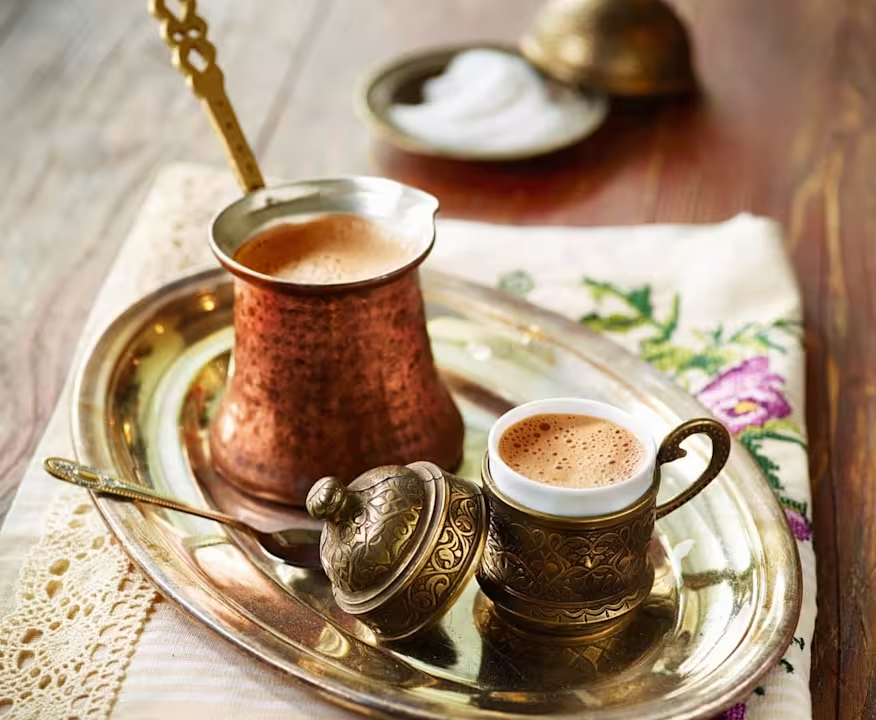
Coffee Culture in Istanbul: From Ottoman Coffeehouses to Contemporary Cafés
Coffee culture in Istanbul has never been only about caffeine. A small cup can mark the end of a meal, accompany a family visit, stretch a conversation for another half hour or simply offer an excuse to sit while the city continues moving outside.
This relationship with coffee has been developing for centuries. The Ottoman coffeehouses of Istanbul created new spaces for conversation and public life; Turkish coffee gradually acquired its own rituals of preparation and hospitality; and in recent decades, a new generation of independent cafés and specialty roasters has added yet another layer to the city’s coffee culture.
What makes coffee culture in Istanbul particularly interesting is that these layers have not neatly replaced one another. Turkish coffee still appears after lunch or during a visit at home, while espresso bars and specialty cafés have become part of everyday life in neighbourhoods such as Karaköy, Cihangir, Moda and Kadıköy. Tea, meanwhile, remains the drink that accompanies much of the working day.
To understand coffee in Istanbul, then, it helps to look beyond what is in the cup. Its history is also a story about how Istanbul’s residents have met, talked, exchanged news, welcomed guests and made room for sociability in one of the world’s busiest cities.
How Coffee Became Part of Istanbul
Coffee was not originally an Ottoman drink. The plant originated in East Africa, while the drinking culture that would eventually reach the Ottoman capital developed particularly strongly in Yemen and the Arabian Peninsula. By the sixteenth century, coffee had reached Istanbul, a city unusually well placed to turn a new beverage into an urban phenomenon.
The Ottoman capital was already a meeting point for merchants, sailors, officials, craftsmen, scholars and travellers. Goods and habits moved through its ports and markets constantly, but coffee was different from many other commodities because its influence extended beyond the kitchen. Drinking it required relatively little: a small cup, some time and usually someone to share that time with. It could follow a meal, accompany a discussion or become the reason for gathering in the first place.
The emergence of coffeehouses during the sixteenth century gave this new habit a physical space in the city. For the price of a cup, people could spend time together somewhere that was neither home nor workplace, and this gradually created a new form of urban sociability.
Ottoman coffeehouses were not identical establishments serving identical customers. Their character could change according to neighbourhood, period and clientele. Some became associated with craftsmen and tradesmen, others with Janissaries or particular professional groups. Storytellers and performers could attract audiences, while games, poetry, gossip and news all found their way into coffeehouse life.
This made them important places for the circulation of information. Long before newspapers or social media could deliver a constant stream of updates, news travelled through conversation, and a busy coffeehouse was an obvious place to hear what was happening elsewhere in the city.
That social role also explains why coffeehouses periodically made the authorities uncomfortable. A room full of people spending hours talking could just as easily become a place for political discussion, satire or criticism. Attempts were made at different points in Ottoman history to restrict coffeehouses, and coffee itself encountered religious objections during its early years. Yet neither the beverage nor the institution surrounding it disappeared. Coffee had already answered a social need that proved difficult to suppress.
Turkish Coffee: The Ritual Around the Cup
Visitors sometimes assume that Turkish coffee describes a particular variety of bean. In fact, what distinguishes it is primarily the preparation.
The beans are ground extremely finely and the coffee is traditionally prepared in a small pot called a cezve. It is served without filtering, allowing the grounds to settle at the bottom of the cup. Good preparation depends on proportion, heat and timing, and the layer of foam that forms on top has traditionally been regarded as a sign of a well-made coffee.
The serving itself is deliberately modest. Turkish coffee arrives in a small cup, often accompanied by water and sometimes something sweet. Yet the size of the drink is almost the opposite of the social occasion surrounding it. The coffee may be finished quickly; the conversation rarely needs to be.
This is where the history of Turkish coffee becomes more interesting than the brewing technique. Over time, coffee became closely associated with hospitality. Offering it to someone entering your home is not simply a question of whether that person needs a drink. It creates a reason to sit together and signals that the visit is worth giving time to.
Some of the traditions surrounding Turkish coffee make this relationship particularly visible. During kız isteme, the family visit traditionally associated with asking for a woman’s hand in marriage, the prospective bride prepares coffee for the guests. A playful custom, still practiced by some families today, is to put salt into the prospective groom’s coffee and watch whether he drinks it without complaint. The details vary from family to family, and the ritual has naturally changed over time, but the important point is that coffee has become part of the ceremony itself.
Then there is kahve falı, the practice of reading the patterns left by coffee grounds. After the coffee is finished, the cup is turned upside down onto its saucer and left to cool before the shapes inside are interpreted. Some people believe in it more seriously than others, but treating fortune telling only as superstition misses much of its social function. It prolongs the moment around the table. Friends begin interpreting shapes and inevitably move on to relationships, work, travel and whatever else is happening in their lives.
The cup may have provided the excuse, but conversation is usually the real event.
In 2013, UNESCO inscribed Turkish coffee culture and tradition on the Representative List of the Intangible Cultural Heritage of Humanity. Significantly, the recognition concerns more than a recipe. Preparation, hospitality and the social customs surrounding coffee are part of the tradition, which is why Turkish coffee remains living heritage rather than simply a historical beverage.
If Coffee Is So Important, Why Does Istanbul Drink So Much Tea?
One of the first things visitors notice after arriving in Türkiye is that a country famous internationally for Turkish coffee seems to be drinking tea almost constantly.
The apparent contradiction makes more sense when the two drinks are understood as occupying somewhat different places in everyday life.
Tea became especially important during the twentieth century as domestic production expanded around Rize and the eastern Black Sea. It was affordable, could be prepared in quantity and could remain ready for repeated serving throughout the day. Those practical qualities helped it become embedded in daily routines.
Walk through Istanbul and tea seems to follow the rhythm of the city. It arrives with breakfast, appears on shop counters and office desks throughout the day, and is offered almost automatically when someone sits down for a conversation. In workshops and small businesses, glasses travel back and forth on trays; on ferries crossing the Bosphorus, drinking tea while watching the shoreline has become such an ordinary pleasure that it hardly needs explanation.
Coffee occupies a slightly different space. It is not necessarily formal, but it tends to create a more defined pause. Turkish coffee after a meal, for example, often signals that nobody needs to leave the table just yet. Meeting someone for coffee implies sitting down rather than simply drinking something while continuing with another task.
This distinction should not be made too rigidly—people drink both in countless different circumstances—but it helps explain why tea could become the everyday drink without diminishing the cultural importance of coffee.
In fact, the coexistence of the two says something useful about Istanbul itself. The city has room for both speed and interruption. Tea can accompany whatever is already happening; coffee often becomes an occasion.
From Ottoman Coffeehouses to Istanbul’s Contemporary Café Culture
The Ottoman coffeehouse did not remain frozen in time, and neither did Istanbul. During the nineteenth and twentieth centuries, the city’s social spaces changed along with its population, politics and relationship with Europe. New forms of cafés appeared, different neighbourhoods developed their own social cultures and the ways people spent time outside the home continued to evolve.
The most recent transformation has been particularly visible over the last two decades. Independent coffee shops and specialty roasters have become part of the landscape in Karaköy, Galata, Cihangir, Beşiktaş, Kadıköy, Moda and many other parts of the city. Espresso, filter coffee and pour-over methods now sit comfortably alongside a coffee tradition that arrived in Istanbul almost five centuries ago.
At first, it is tempting to describe this as a conflict between old and new. The reality is much less dramatic.
Someone who discusses single-origin beans and brewing temperatures at a specialty café may still expect Turkish coffee when visiting relatives. A person drinking a flat white in Karaköy in the afternoon may have started the morning with several glasses of Turkish tea. The same household can contain an espresso machine, a cezve and a traditional double teapot without anyone finding the combination unusual.
This ability to absorb rather than simply replace is characteristic of Istanbul’s wider food culture. New tastes arrive and find their place alongside older habits, sometimes changing them and sometimes remaining surprisingly separate.
There is also more continuity between the old coffeehouse and the contemporary café than their appearance suggests. A traditional neighbourhood coffeehouse with backgammon boards and tea glasses may look nothing like a minimalist specialty café filled with laptops, but both provide something the city has needed for centuries: somewhere between home and work where people can spend time in the presence of others.
The clientele has changed. The drinks have multiplied. The furniture certainly looks different. Yet the social need behind these spaces is remarkably familiar.
Coffee and the Rhythm of Modern Istanbul
This is perhaps the most revealing way to think about coffee culture in Istanbul today. The city is enormous, crowded and often exhausting. Ferries arrive and depart, trams move through packed streets, traffic builds on both sides of the Bosphorus and millions of people cross between neighbourhoods as part of an ordinary working day.
Cafés create small interruptions within that movement.
Some of these pauses are spectacular: a terrace looking across the Bosphorus, perhaps, or a table beside one of the city’s historic landmarks. Many more are completely ordinary. Two friends sit outside a neighbourhood café. A shopkeeper drinks Turkish coffee after lunch. Someone spends an hour reading while waiting for the evening traffic to ease.
For visitors, these quieter moments can reveal more about Istanbul than rushing from one famous sight to another. Sitting somewhere long enough to notice who else comes in, how long people stay and what they order gives a glimpse of the city as a lived place rather than a collection of attractions.
That is also why searching for the single “best place for Turkish coffee in Istanbul” can sometimes miss the point. There are historic coffee businesses worth seeking out and contemporary cafés doing excellent work, but coffee culture in Istanbul is not contained in one famous address.
It can be found around the Grand Bazaar and the historic peninsula, where coffee belongs to a much older world of merchants, craftsmen and commercial life. Across the Bosphorus, Kadıköy and Moda offer a different mixture of neighbourhood culture and contemporary cafés. Karaköy and Galata add yet another layer, combining historic commercial streets with modern roasters and a younger café scene.
But a memorable coffee experience can also happen somewhere that never appears in a guidebook: after lunch in a small restaurant, at the home of someone you have just met, or when a shopkeeper asks whether you would like coffee while you talk.
Context often matters more than the address.
Why Coffee Culture in Istanbul Still Matters
More than four centuries after coffee first became part of Istanbul’s urban life, almost everything surrounding it has changed. The Ottoman coffeehouse is no longer the institution it once was, the city has expanded far beyond its historical boundaries and contemporary Istanbul drinks coffees that would have been unimaginable to earlier generations.
Yet the habit of creating social time around a cup has proved remarkably durable.
That is why the history of coffee in Istanbul is ultimately less about a beverage than about people. Coffeehouses tell us how information once circulated through the city and how urban communities formed outside the home. Turkish coffee traditions reveal the importance of hospitality and ceremony. Modern cafés show how a younger, globally connected Istanbul continues to adapt those social spaces to contemporary life.
Even the contrast between coffee and tea adds another layer to the story. Istanbul does not need to choose between an Ottoman tradition and a modern café culture, or between Turkish coffee and a morning espresso. Like so much of the city’s cuisine, these habits have accumulated rather than replacing one another completely.
Perhaps that is the most characteristically Istanbul aspect of the whole story. A drink that arrived from elsewhere became deeply local, survived enormous political and social change, acquired rituals of its own and continues to evolve without losing its ability to bring people to the same table.
For a visitor, understanding coffee culture in Istanbul therefore requires very little expertise. Order a coffee, but do not rush it. Pay attention to the room, the neighbourhood and the people around you. The most interesting part of the experience may turn out to be everything that happens between the first sip and the moment you finally decide to leave.